
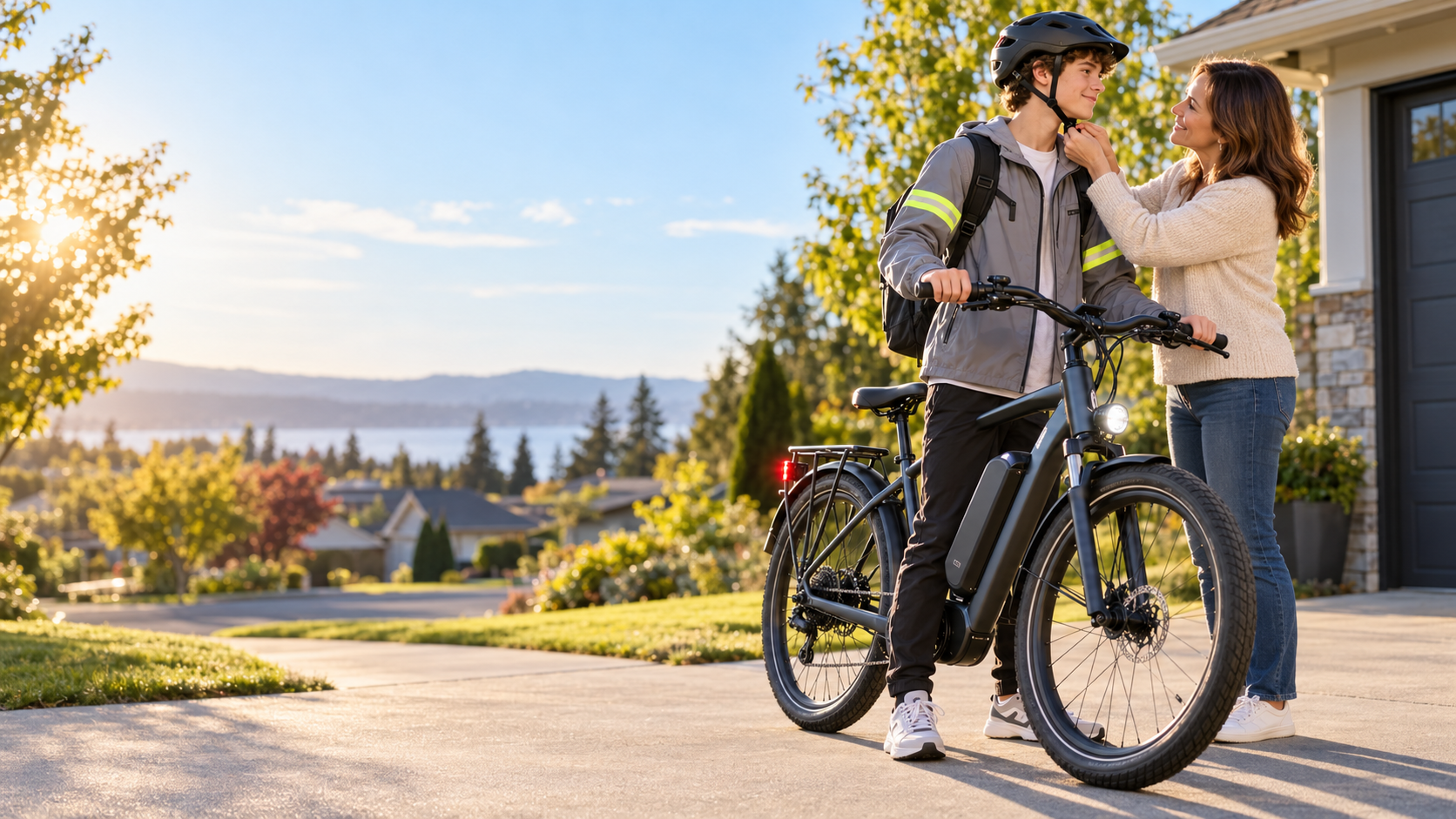
Walk past a middle or high school at dismissal and you can see the shift. Pedal bikes and yellow buses have given ground to something quieter and considerably faster. E-bikes have taken over teen transport, and on paper it makes sense — they give teenagers independence, keep them outdoors, and retire the afternoon taxi service.
The trauma data has moved in the same direction, and faster.
Children made up 4.18% of recorded e-bike injury cases in 2019. By 2023 they were 49.8% (American College of Surgeons Bulletin, June 2026, citing National Electronic Injury Surveillance System data). This is not an argument for banning e-bikes. It is an argument for treating them as what they mechanically are.
Key Takeaways
- Children went from a small fraction of recorded e-bike injuries to roughly half of them in four years. At one San Diego children's hospital, e-bike patients accounted for 40% of trauma activations in 2025.
- A standard bicycle helmet is built around a ~14 mph impact. A Class 3 e-bike assists to 28 mph. The mismatch is the most fixable problem on this list.
- Helmet use among injured young riders is very low — 19% in one pediatric emergency series, and zero out of 20 children in a neurosurgical series of cranial injuries.
- Know which class you are buying. Class 1 and 2 assist to 20 mph; Class 3 assists to 28 mph and is age-restricted in most states that regulate it.
What the injury data actually shows
The rise is real, it is concentrated in children, and it is about speed.
The clearest national signal comes from the National Electronic Injury Surveillance System, the emergency-department sample the Consumer Product Safety Commission runs. Pediatric patients went from 4.18% of recorded e-bike injury cases in 2019 to 49.8% in 2023.
Individual trauma centres describe the same curve more starkly. Rady Children's Health in Orange County treated one pediatric e-bike crash patient in 2021 and more than 220 in 2025. At Rady Children's in San Diego, 446 e-bike patients in 2025 accounted for 40% of the institution's trauma activations (ACS Bulletin, June 2026).
The injuries are not scraped knees. In one neurosurgical series of children with e-bike-related cranial trauma, 85% sustained skull fractures, 30% had intracerebral contusions, 30% had subdural haematomas and 15% had epidural haematomas. In crashes at more than 20 mph, nearly half of pediatric e-bike injuries involved the head, neck or face, and 24.1% involved internal organ injury.
And the protective equipment is mostly absent. One pediatric emergency study recorded helmet use in 19% of cases. In that neurosurgical series of 20 children with cranial trauma, none wore a helmet.
The single most useful sentence for a parent in all of this: the injuries that fill these studies are high-speed injuries to unhelmeted heads. Both halves of that are things a household can change this week.
Why an e-bike is not just a faster bicycle
It is easy to look at an e-bike and see a bicycle with a battery bolted on. Mechanically it behaves more like a moped.
Speed and weight compound each other
A child's pedal bike tops out around 10–12 mph under leg power. Class 1 and Class 2 e-bikes assist to 20 mph; Class 3 assists to 28 mph. The motor and lithium-ion battery also make the frame substantially heavier.
Those two factors do not add — they multiply. Kinetic energy rises with the square of speed, so a crash at 20 mph carries roughly four times the energy of one at 10 mph before you account for the extra mass. The practical consequences are longer stopping distances and harder impacts.
Traffic judgement is a learned skill, and they have not learned it
A 13-year-old has not taken driver's education. Right-of-way, blind spots, lane position, reading whether a driver at an intersection has actually seen you — these are trained instincts, and they are the whole job at 20 mph in traffic. The bike supplies the speed of a motor vehicle without any of the preparation that normally precedes it.
Carrying a passenger changes the machine
Teenagers give each other rides on single-rider e-bikes constantly. A passenger shifts the centre of gravity, lengthens braking distance and makes the bike behave unpredictably in a swerve. Unless the bike was manufactured with a second seat, footpegs and a rated payload for two, it is a one-person machine.
The helmet is usually the wrong helmet
This one deserves its own section, below, because it is the cheapest problem to solve.
Know which class you are actually buying
Most states now sort e-bikes into three classes, and the class determines both the top assisted speed and, often, the minimum age.
| Class | How the motor engages | Top assisted speed |
|---|---|---|
| Class 1 | Pedal-assist only | 20 mph |
| Class 2 | Throttle — no pedalling required | 20 mph |
| Class 3 | Pedal-assist only | 28 mph |
The framework was developed by the bicycle industry — PeopleForBikes and the Bicycle Product Suppliers Association — rather than by a federal regulator, and around 40 states have since adopted some version of it.
Two practical implications. Class 3 machines are commonly restricted to riders of 16 or 17 and are frequently barred from shared-use paths and trails. And a Class 2 throttle bike requires no pedalling at all, which means a child who cannot yet ride a bicycle competently can still travel at 20 mph on one.
Check your own state and city. Because this grew out of industry model legislation rather than a national rule, the age thresholds, helmet mandates and path access genuinely differ across state lines and sometimes between neighbouring municipalities.
The helmet question, answered properly
The mandatory US bicycle helmet standard is built around a crash at roughly 14 mph. Your teenager's e-bike assists to 20 or 28.
Every bicycle helmet sold in the United States must meet CPSC 16 CFR Part 1203. It is a real standard and a good one — for bicycle speeds. Europe developed a separate standard for faster machines: NTA 8776, a Dutch specification for speed-pedelec helmets, built around assistance up to 45 km/h, or about 28 mph. Helmets certified to it typically offer more coverage at the temples and the back of the head, which is where a faster fall tends to land.
A correction worth making, because the error is circulating. NTA 8776 is a Nederlandse Technische Afspraak — a Dutch Technical Agreement, published by the Dutch standards body NEN. It is sometimes written up online as "NMT" or expanded into something about "networked micro-mobility." That is wrong, and if a retailer tells you it, treat the rest of their safety advice with care.
What to do with this: for a Class 1 or Class 2 bike used sensibly, a well-fitted CPSC helmet is a reasonable floor. For a Class 3 machine, or any teenager who rides at the top of the assist range, an NTA 8776-certified helmet is the upgrade that maps most directly onto the injury pattern in the data. A correctly fitted cheap helmet still beats an expensive one worn loose or left at home.
Rules worth setting before the first ride
Setting conditions here is not overprotective. It is the same reasoning that produces a graduated driver's licence.
Match the class to the rider. Confirm what class the bike is before you buy, and confirm your state's minimum age for it. A 13-year-old does not need a 28 mph machine.
Buy the helmet for the speed. See above. Fit matters more than price: level on the head, snug strap, no more than two fingers under the chin.
No passengers, unless the bike is built for one. Dual seat, footpegs, rated payload — or it carries one person.
Ride together first. Before solo trips, practise hard braking from full assist speed, four-way stops, signalling, and scanning at driveways. Teenagers routinely overestimate their stopping distance because a pedal bike never needed one that long.
No earbuds, no phone. At 20 mph, hearing a car approach from behind is a safety system.
No speed-limiter tampering. There are tutorials online for bypassing the factory speed cap. Doing it voids the machine's legal status as a bicycle, likely voids insurance, and puts a teenager on an unregistered motor vehicle with bicycle brakes. Say this out loud rather than assuming it will not occur to them — the ACS notes that modified e-bikes have been recorded exceeding 50 mph.
Agree where it can be ridden. Path and trail access varies by class and by city, and "everyone else rides there" is not a permission.
Finding the balance
E-bikes are not the problem. They are a genuinely good thing — active, green, and a real extension of a teenager's independence at exactly the age when that starts to matter.
But the data is describing a specific failure, not a general one: fast machines, unhelmeted or under-helmeted heads, and riders who have not yet learned to read traffic. Each of those is addressable, and none requires taking the bike away.
Treat it as the motor vehicle it mechanically is, and most of the risk in these studies goes with it.
Frequently asked questions
Are e-bikes safe for a 13-year-old? It depends heavily on the class and the setting. A Class 1 pedal-assist bike on quiet residential streets is a different proposition from a Class 3 machine in traffic — and Class 3 bikes are age-restricted in most states that regulate them, commonly to 16 or 17. Check your state before buying.
Does my teenager need a special e-bike helmet? For Class 3 machines, or any rider who regularly reaches the top of the assist range, a helmet certified to NTA 8776 is designed for that speed in a way a standard CPSC bicycle helmet is not. For slower Class 1 and 2 riding, a well-fitted CPSC helmet is a reasonable floor. Fit beats price either way.
Can two teenagers ride one e-bike? Only if it was manufactured for it — dual seat, footpegs and a rated two-person payload. A passenger on a single-rider frame changes the centre of gravity and lengthens braking distance.
Is it illegal to remove the speed limiter? Modifying the factory speed cap generally takes the machine outside the legal definition of an electric bicycle, which changes what it is and where it may be ridden. Specific consequences vary by state — but it is not a grey area worth exploring on a child's bike.
Need Professional Investigative Help?
Moses Castillo Investigations provides confidential, professional investigative services. Whether you need support with a criminal case, civil matter, or community safety concern, we are here to help. Consultations are free and completely confidential.